Enter your current and target salary to find your yearly growth rate. This calculator benchmarks your goal against data from BLS, Levels.fyi, and 40+ sources. It shows whether your salary growth keeps pace with industry averages or falls behind the curve.
Quick Summary: How This CAGR Calculator Works
You enter your current monthly salary and your target monthly salary
You pick a time horizon (1–30 years) and your industry
The calculator shows your required yearly growth rate with a difficulty rating
You compare against median, top-25%, and top-10% benchmarks for your field
The results include year-by-year projections and career tips
You enter your salary data and the calculator shows your required growth rate in seconds.
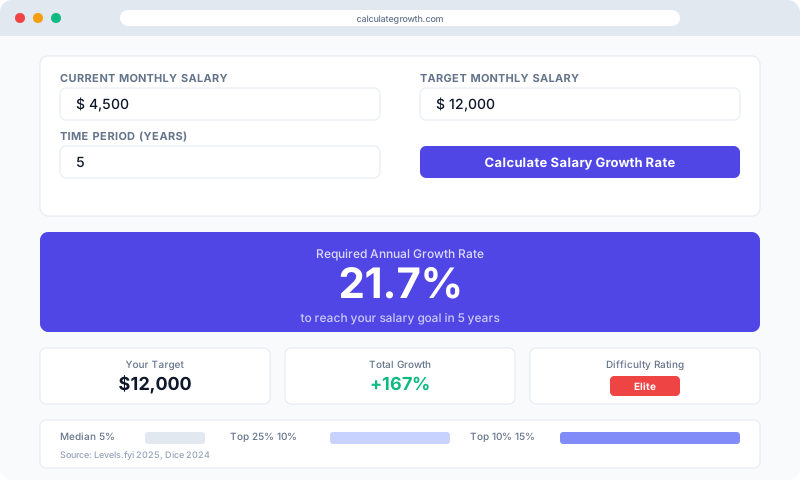
Example: The calculator finds a 5-year growth path from $4,500 to $12,000 per month.The formula breaks down salary growth into one yearly percentage rate.
Full Name
Compound Annual Growth Rate
Abbreviation
CAGR
Formula
(End Value / Start Value)1/n − 1
Inputs Required
Beginning value, ending value, number of years
Output
Annualized percentage growth rate
Typical Range
3–15% for salary growth; 7–12% for equity investments
Required Annual Growth Rate
--
to reach your salary goal in -- years
Your Target
--
Total Growth
--
Difficulty Rating
--
Reality Check
Industry Benchmarks
Market Distribution
Growth Projection
Year-by-Year Breakdown
How to Achieve This Growth
Industry Benchmarks Overview
Tech Industry
Median Growth:5-7%/year
Top 10%:15%+/year
Sales & Business
Median Growth:8-12%/year
Top 10%:20%+/year
SaaS Startups
Median Growth:40%/year
Top 10%:120%+/year
Use the salary CAGR calculator above to see how your growth target compares to industry benchmarks
What Is CAGR and How Compound Growth Works
Compound growth means each year's gain builds on the prior year's total. This creates a faster growth path over time. CAGR is the yearly average rate that smooths this path into one percentage. The formula captures compounding. It mirrors how salaries grow through raises, promotions, and job changes.
The initial value is the starting salary or investment amount you plug into the equation. The end value is your target pay. Warren Buffett calls compound growth "the most powerful force in finance" in his Berkshire Hathaway letters. Applied to careers, the same idea answers a clear question: "At what steady rate must my pay rise to hit a specific target?"
Two professionals start at $60,000. One sustains a 7% yearly rate and reaches $84,153 in five years. The other grows at only 4% and lands at $73,000. That 3-point gap creates an $11,000+ yearly difference. This shows why tracking your growth rate matters. A yearly rate is an equivalent percentage drawn from data across any time span.
Stock analysts use this metric to judge portfolio results. Career-minded workers can apply the same method to their earning power. Our examples page walks through several real-world scenarios step by step.
How to Calculate Your Salary CAGR
The Growth Rate Formula
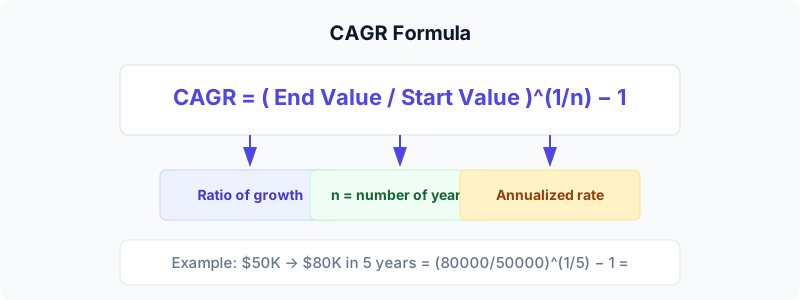
You calculate your salary CAGR with just three inputs. The formula requires exactly a start value, an end value, and the number of years:
CAGR = (End Value / Start Value)1/n − 1
Here n is the number of years. A compound return is a return where gains are reinvested to create more earnings. The formula accounts for this effect by design. Jacob Bernoulli described the compound interest equation in the 17th century, and the CAGR formula builds on that same math. You multiply the decimal result by 100 to get a percentage. For a deeper look at the math, see our formula guide.
Worked Calculation Example
Suppose your annual salary is $50,000 today and your five-year target is $80,000:
Divide target by current pay: $80,000 / $50,000 = 1.60
Raise to the power of 1/n (n = 5): 1.600.2 = 1.0986
Subtract 1: 1.0986 − 1 = 0.0986
Express as a percentage: 0.0986 × 100 = 9.86% per year
That 9.86% yearly rate means you need roughly a 10% raise every year for five years in a row. The calculator at the top of this page does this math in seconds. It then compares your result against real industry benchmarks so you can judge if your goal is realistic.
This metric describes an equivalent steady rate. Your actual path may include a 0% year followed by a 20% jump from a job switch. The formula smooths those swings into one yearly figure. You can explore more scenarios on our examples page.
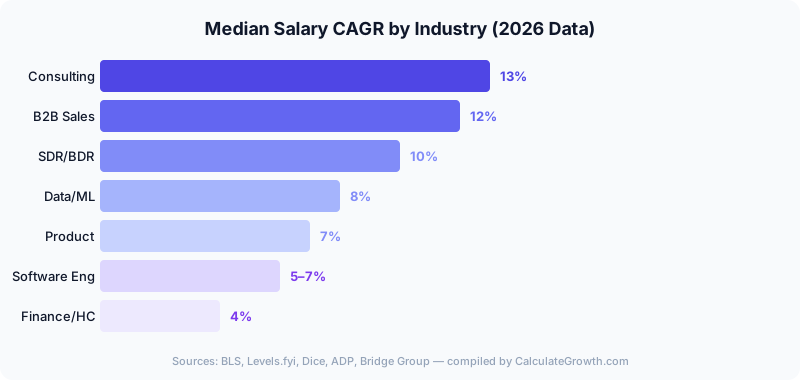
CAGR Benchmarks by Industry (2026 Data)
CAGR benchmarks by industry separate wishful thinking from real goals. The data below comes from 40+ sources: the U.S. Bureau of Labor Statistics longitudinal wage data, Levels.fyi 2025, Dice, ADP, and sector reports. Investopedia defines CAGR as "the rate of return needed for an investment to grow from its start balance to its end balance."
Median salary CAGR varies significantly across industries — consulting and sales lead, while healthcare and finance trail.
AI and ML specialists earn an 18% premium over general software roles in 2026. This makes Data Science the fastest-growing tech field. Engineers at FAANG-tier firms often see higher yearly returns because stock grants grow alongside base pay. The median tech salary in 2026 is $145,000 according to BLS data.
High-quota Account Executives often double their total pay within 3-4 years through accelerator clauses. That translates to 25%+ CAGR on total earnings.
Early hires at fast-growing startups can see outsized pay growth through equity vesting and quick promotions. This path carries higher risk than jobs at large firms. For a comparison between CAGR and IRR (which better handles irregular cash flows from equity events), visit our metric comparison guide.
Finance, Healthcare & Traditional Industries
Industry
Median CAGR
Top 25%
Top 10%
Finance / Accounting
4%
7%
10%+
Management Consulting
13%
18%
25%+
UX / Product Design
6%
10%
15%+
Healthcare
4%
6%
8%+
Firms like McKinsey, BCG, and Bain drive rapid growth through an up-or-out ladder. Each tier delivers 20-30% pay jumps. Healthcare pay follows seniority-based scales that produce steady but slower yearly gains. Our wealth-building guide covers how these salary gains turn into long-term wealth.
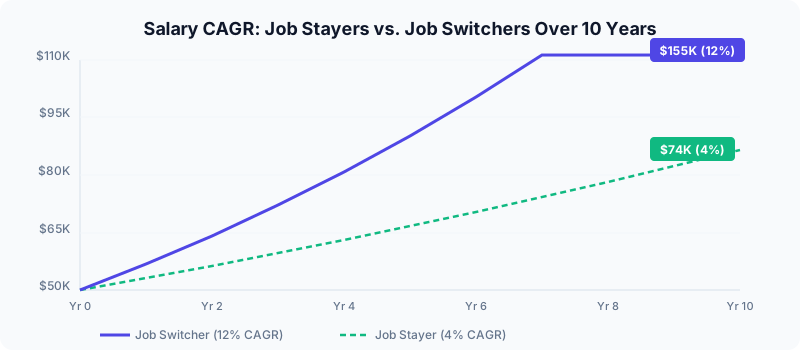
Over 10 years, a 12% CAGR (job switcher) produces roughly double the salary of a 4% CAGR (job stayer) — starting from the same $50K base.
What Qualifies as Strong Compensation Growth?
Strong pay growth depends on your starting salary, industry, and career plan. The time horizon is the number of years between your start and end dates. A longer span allows lower yearly rates to reach the same total gain. A healthy salary CAGR ranges from 5% to 12% per year for most workers. Here is a framework based on BLS data, ADP workforce reports, and surveys:
Below 3% yearly growth: This trails inflation in most years and erodes real buying power. Workers who stay in the same role without asking for a raise often land here.
3–5% CAGR: This matches the median for job stayers — standard yearly merit raises plus inflation. About 60-70% of the workforce falls in this band.
5–10% CAGR: This exceeds the norm. It usually requires solid reviews, regular promotions, and selective job changes. About 20-30% of workers reach this tier.
10–15% CAGR: This is strong growth — often from switching employers every two years, targeting high-growth sectors, or fast rises in consulting or sales. The top 10-15% reach this level.
15%+ CAGR: This is rare and usually tied to big career events: executive roles, startup equity wins, or mastering a scarce skill. Only the top 5% achieve it.
Stayers versus switchers: BLS and ADP data show that workers who change employers every 2-3 years get 10-15% raises per move. Stayers receive 3-5% yearly raises. Over a decade, smart switching builds 50-100% more total earnings. But changing too often — every 12 months — can signal instability and limit your options.
Strategies to Raise Your CAGR
Five proven strategies can raise your salary CAGR above the industry median. Each one targets a different lever — from negotiation to skill-building to employer choice.
Negotiate with Market Data
Negotiation has the biggest one-time impact on your earning path. Levels.fyi and Glassdoor data shows that candidates who negotiate get 15-25% better offers. You approach every offer with benchmark data, request 48 hours to review, and practice counteroffers with a trusted peer. A single 10% win compounds over your whole career and lifts your yearly return for decades.
Time Your Job Moves Strategically
Switching employers every 2-3 years resets your pay to current market rates. These rates often beat internal raise budgets. You should target firms in their rapid-growth phase, where hiring pressure opens up budgets. A move during a strong hiring market in your field boosts the premium you can command.
Build Scarce, High-Value Expertise
AI/ML, cloud architecture, cybersecurity, and data engineering carry 15-30% pay premiums in 2026. Certifications like AWS Solutions Architect, GCP Professional, and PMP give verifiable proof of skill. Specialization works best when rooted in truly scarce skills rather than short-lived trends.
Join Companies on Steep Growth Curves
Firms growing revenue 50%+ per year promote faster, grant bigger equity packages, and raise salaries above market to keep talent. Early hires at breakout startups have seen 3-5x total pay growth within four to five years through vesting and pay bumps. You can check company growth paths on ChartMogul or Sacra before making a move.
Common Questions About Growth Rate Calculations
Readers ask these questions about growth rate calculations most often.
What does CAGR stand for?
CAGR stands for Compound Annual Growth Rate. It is a metric that captures the smoothed yearly increase of any value over a set period. For salaries, it smooths bonuses, flat years, and big promotion bumps into one yearly percentage.
How is the yearly growth rate calculated?
You apply the formula: CAGR = (Target Salary / Current Salary)1/n − 1, where n is the number of years. Growing from $50,000 to $80,000 in 5 years gives ($80K/$50K)0.2 − 1 = 9.86% per year.
What growth rate should I target?
A strong target depends on your field. Job stayers average 3-5% per year. Switchers land 10-15% per move. Any yearly rate above 7% beats the workforce median across industries.
Does switching jobs really boost earnings?
BLS and ADP data confirm that job changers earn 10-15% more per move, versus 3-5% yearly raises for those who stay. Changing employers every 2-3 years compounds into much higher lifetime earnings.
What growth do tech workers typically achieve?
Median tech pay grows at 5-7% per year. Top-quartile performers hit 10-15%, and the top 10% surpass 15-20% by targeting high-paying firms, focusing on AI/ML, and using competing offers. Levels.fyi and Dice 2025 data back these figures.
How does CAGR differ from a simple average growth rate?
CAGR accounts for compounding — it gives the true rate linking start and end values. A simple average adds yearly percentages and divides by n. This method overstates real growth when returns swing from year to year.
Can CAGR measure startup revenue growth?
Yes. Median SaaS revenue CAGR is near 40% for Series A companies. FinTech startups reach 76%+ median. The metric lets you compare firms with different funding stages and time frames on equal terms.
Conclusion: From Numbers to Career Action
Your compound annual growth rate turns years of salary data — or future goals — into one clear number. Whether your target is a steady 5% or a bold 15%, the benchmarks above give you a realistic frame drawn from BLS, Levels.fyi, Dice, and 40+ other sources. The default calculation period is 5 years, but you can adjust it to match any time span.
You can take three steps right now: first, use the calculator at the top of this page to find your required yearly rate; second, compare your result against the industry benchmarks listed above; third, explore the formula guide, worked examples, and investment projections to deepen your knowledge.
CAGR tracking turns vague career goals into clear targets. You should revisit your numbers each quarter, adjust your plan based on market shifts, and treat your compound annual growth rate as the guide for career planning.
You enter your salary data above, and the calculator builds a personalized CAGR report with industry benchmarks.
Daniel has spent over eight years analyzing compensation trends across technology, finance, and consulting sectors. He holds a CFA charter and previously led salary benchmarking research at a Fortune 500 HR analytics firm. His work draws on BLS longitudinal surveys, Levels.fyi verified submissions, Dice recruiter data, and ADP payroll aggregates — totaling 40+ independent sources reviewed each quarter.