CAGR Formula Explained
The CAGR formula is the mathematical equation that converts total growth into a single annualized percentage rate. This page breaks down each variable, walks through the algebra step by step, and shows how the CalculateGrowth tool applies the formula to salary, investment, and revenue scenarios.
Updated
- Full Name
- Compound Annual Growth Rate
- Abbreviation
- CAGR
- Formula
- (End Value / Start Value)1/n − 1
- Inputs Required
- Beginning value, ending value, number of periods
- Output
- Annualized percentage return
- Also Known As
- Compound growth equation, annualized return formula
The Mathematical Foundation
CAGR stands for Compound Annual Growth Rate. It measures the mean annual growth rate of a value over a specified period longer than one year. Unlike simple averages that can distort the picture by ignoring compounding effects, CAGR smooths out volatility to produce a single, steady rate that would theoretically transform a beginning value into an ending value over the same time frame. The formula requires three inputs: beginning value, ending value, and number of years.
Mathematically, this compound growth equation is expressed as follows:
Here, n represents the number of years in the measurement period. The exponent 1/n converts total growth into a per-year figure, distributing the cumulative change evenly across each year. Because the formula uses geometric progression rather than arithmetic averaging, it captures the reality that each year's growth builds on the prior year's result. CAGR is a geometric mean, not an arithmetic mean. The result is always expressed as a decimal before converting to a percentage—for instance, a calculated value of 0.08 corresponds to 8%.
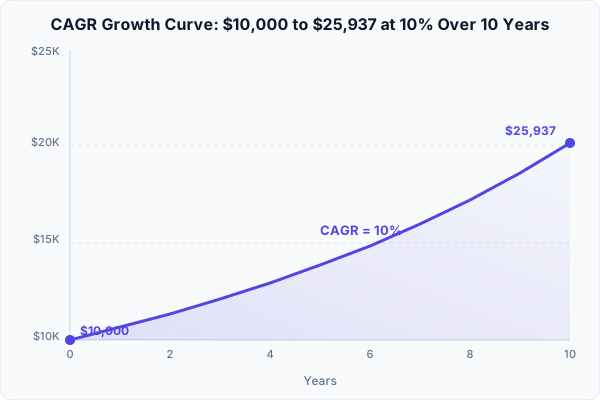
Consider a salary that rises from $50,000 to $73,000 over five years. Plugging those numbers in: ($73,000 / $50,000)1/5 − 1 = 0.0787, or about 7.87% per year. That single percentage tells you the steady compound annual growth rate that would have produced the same outcome, even if actual raises varied year to year. A 10% CAGR means your investment doubles roughly every 7.2 years. You can try this growth rate calculation yourself using our main calculator to verify the result instantly.
The formula assumes reinvestment at a constant rate throughout the period. For financial instruments, this means gains are reinvested rather than withdrawn. For salary analysis, it assumes each raise compounds on the previous total compensation figure. This assumption works well for long-term trend analysis but can mask short-term fluctuations—an advantage when you need a clean comparison metric, and a limitation when volatility itself matters. A negative CAGR indicates a decline in value over the period, signaling that the ending value fell below the starting point.
Expressing returns as an annualized figure also makes cross-comparisons straightforward. A five-year investment and a twelve-year investment become directly comparable once both are stated as compound annual growth rates. Without annualization, you'd be left comparing raw percentages across mismatched durations, which tells you very little about relative performance.
CAGR Formula Variations
Salary Growth CAGR
Tracking salary progression over a career requires a formula that accounts for compounding raises. The salary-specific version looks identical to the standard growth rate formula:
Professionals use this annualized return formula to benchmark their compensation trajectory against industry medians. According to the U.S. Bureau of Labor Statistics Employment Cost Index, wages and salaries for civilian workers have historically grown between 2.5% and 4.5% annually. Knowing your personal salary CAGR lets you see whether you're outpacing, matching, or trailing that range. For detailed step-by-step calculations, see our worked examples page.
Switching jobs often produces step-function jumps in pay rather than steady annual increases. The annualized return metric flattens those spikes into a single trend line, which is useful for setting realistic long-term salary targets without getting anchored to any single raise event.
When evaluating compensation packages that include equity or bonuses, apply the salary CAGR to your total compensation figure rather than base salary alone. This provides a more accurate reflection of your overall earnings trajectory. You can compute your CAGR with either base salary or total compensation to see how each component contributes to your growth.
Investment Growth CAGR
Portfolio managers and individual investors rely on CAGR to evaluate fund performance, compare asset classes, and set return expectations. The investment version uses portfolio value at the start and end of the holding period:
Historical data from the NYU Stern School of Business historical returns dataset compiled by Professor Aswath Damodaran shows that the S&P 500 has delivered a compound annual growth rate of roughly 10% (nominal) over the past century. That figure, however, obscures years of 30%+ gains alongside years of 30%+ losses. CAGR deliberately strips away that noise to present the underlying trend. Because it is fundamentally a geometric mean formula, it accounts for the compounding effect that arithmetic averages miss entirely.
Analysts frequently pair CAGR with standard deviation to give a fuller picture: the annualized return tells you where you ended up, and the standard deviation tells you how bumpy the ride was. Together, these two metrics form the backbone of modern risk-return analysis. Understanding the difference between CAGR and other metrics like IRR can sharpen your analysis further—our CAGR versus IRR comparison explains the distinctions in detail.
When applying CAGR to your own portfolio, be mindful of contributions and withdrawals during the holding period. The standard formula assumes no additional cash flows—only the starting and ending balances matter. If you made regular deposits, consider using a time-weighted return instead. For straightforward lump-sum investments, try the growth tool to see your annualized performance at a glance.
Revenue Growth CAGR
Businesses presenting earnings reports or fundraising decks often cite revenue CAGR to demonstrate consistent top-line momentum. The formula remains structurally identical:
Startup founders and CFOs favor this metric because it communicates growth trajectory in a single number that investors can immediately benchmark against competitors. A SaaS company posting 40% revenue CAGR over three years signals a very different growth profile than a traditional manufacturing firm at 6%, even if both experienced uneven quarterly results.
Revenue CAGR also helps leadership teams set internal targets. By working the formula backward—deciding on a desired CAGR and solving for the ending revenue—teams can establish concrete annual milestones. This reverse application turns the growth rate formula from a backward-looking metric into a forward-looking planning tool.
When to Use CAGR
This metric works best when you need to compare growth rates across different time horizons or strip away short-term volatility. Choosing the right CAGR application depends on the question you're trying to answer and the nature of the underlying data.
Select CAGR when:
- Benchmarking performance across unequal periods — comparing a 3-year salary trajectory against a 7-year career phase, or evaluating two funds with different inception dates.
- Presenting growth to stakeholders — board presentations, investor decks, and annual reviews benefit from a single annualized return figure that tells a clear story.
- Setting long-term targets — reverse-engineering the formula to find the required annual growth rate for a future goal, such as reaching a $200,000 salary from $120,000 in eight years.
- Filtering out short-term noise — market corrections, one-time bonuses, or seasonal revenue dips get smoothed into the overall trend.
Avoid relying on CAGR in isolation when interim cash flows matter (use IRR instead), when measuring risk-adjusted performance (pair it with volatility metrics), or when the time period is under one year (annualizing partial-year data can produce misleading figures).
CAGR does not account for risk. Two investments might share an identical 8% CAGR, yet one may have experienced wild swings while the other grew steadily. For a more nuanced view, combine the growth rate calculation with metrics like the Sharpe ratio or maximum drawdown. See our real-world scenarios for examples of how CAGR pairs with other financial measures.
Ultimately, the compound annual growth rate is a lens, not a verdict. Pair it with other metrics, apply it to appropriate time frames, and it becomes a powerful tool for salary planning, investment growth tracking, and business strategy. Run your own numbers through the free CalculateGrowth calculator to see how different inputs shape the CAGR formula result.