- CAGR
- Compound Annual Growth Rate — smoothed annualized return
- IRR
- Internal Rate of Return — accounts for all cash flow timing
- XIRR
- Extended IRR — handles irregular dates in spreadsheets
- MIRR
- Modified IRR — uses a separate reinvestment rate
- ROI
- Return on Investment — total gain as a percentage of cost
- TWRR
- Time-Weighted Rate of Return — removes cash flow timing effects
What CAGR Measures
CAGR measures the single, steady rate at which an investment would have grown if it increased by the same percentage every year. CAGR stands for Compound Annual Growth Rate. As an annualized return measure, it strips away the noise of volatile annual returns and delivers one clean number that captures overall performance between a starting value and an ending value over a defined period. The S&P 500 has delivered a historical CAGR of approximately 10% over a 10-year holding period, illustrating how this compound growth metric smooths out market swings.
CAGR requires exactly three inputs: start value, end value, and years. Because of that simplicity, it is widely used to compare fund performance over a 5-year period, benchmark salary increases between 2020 and 2025, and track revenue growth across a decade. CAGR always produces a single unique solution, making it a highly dependable metric. You can calculate your own CAGR in seconds with our free calculator.
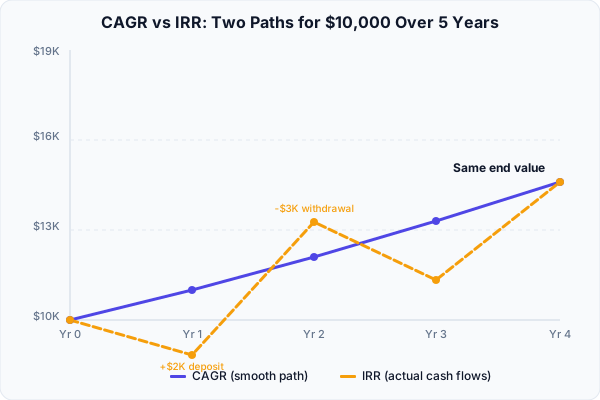
One important limitation: annualized growth calculated via CAGR assumes no additional contributions or withdrawals during the measurement period. If you add money to a portfolio halfway through a 10-year holding period, CAGR cannot reflect how that extra capital influenced total returns. The metric works best when you need a straightforward, apples-to-apples comparison between two end points. CAGR is better for quick, clean comparisons between two values over time.
For a deeper look at the math, visit our CAGR formula breakdown, which walks through each variable step by step.
What IRR Measures
IRR measures the discount rate that makes the net present value of all cash flows equal to zero. IRR stands for Internal Rate of Return. Rather than collapsing an investment into two endpoints, this internal rate comparison considers every cash flow that occurs along the way — deposits, withdrawals, dividends reinvested, or periodic capital calls over quarterly cash flows spanning multiple years.
Private equity funds, venture capital firms, and real estate developers rely on IRR because their deals involve irregular cash movements. A real estate project might require a large upfront purchase, a renovation outlay in year two, rental income over five years, and a final sale after a 10-year holding period. IRR accounts for irregular cash flows, unlike CAGR, producing a rate of return that reflects real-world complexity. A negative IRR indicates the project lost money overall.
The trade-off is computational difficulty. While CAGR can be solved with basic algebra, IRR requires iterative numerical methods — there is no closed-form solution. XIRR is the Excel function that calculates IRR with specific dates, and most analysts rely on spreadsheet functions like IRR() or XIRR() in Excel and Google Sheets. The Investopedia guide to internal rate of return offers a thorough walkthrough of the iterative calculation process and its assumptions.
Another subtlety: IRR can produce multiple solutions when cash flow signs change more than once. IRR also assumes that interim cash flows are reinvested at the IRR itself, which can overstate returns when the computed rate is unusually high. Modified internal rate of return (MIRR) addresses this by allowing a separate reinvestment rate, though it is less commonly reported. Unlike CAGR, IRR factors in the timing of every deposit and withdrawal.
CAGR vs IRR Comparison Table
This side-by-side comparison of CAGR and IRR highlights the core differences between these two return metrics across several practical dimensions, from required inputs to ease of interpretation.
| Feature | CAGR | IRR |
|---|---|---|
| Full name | Compound Annual Growth Rate | Internal Rate of Return |
| Inputs required | Beginning value, ending value, number of years | All cash flows with dates |
| Handles interim cash flows | No | Yes |
| Calculation method | Direct algebraic formula | Iterative / numerical solver |
| Best for | Buy-and-hold, revenue growth, salary growth | Private equity, real estate, projects with multiple cash flows |
| Reinvestment assumption | None (smoothed rate) | Reinvests at IRR rate |
| Multiple solutions possible | No (always unique) | Yes (when cash flow signs change more than once) |
| Ease of interpretation | Very straightforward | Moderate -- requires context |
| Common tools | Any calculator or spreadsheet | Excel IRR() / XIRR(), financial software |
When the underlying investment has no intermediate transactions, CAGR and IRR produce identical figures. Differences emerge only when money enters or exits the investment during the holding period.
When to Use Each Metric
Knowing when to use CAGR versus IRR depends on the structure of the investment and the cash flow pattern you are analyzing.
When CAGR Is the Better Choice
- Comparing investments with different time horizons
- Smoothing volatile annual returns into one number
- Benchmarking portfolio performance against an index
- Tracking salary or revenue growth over 3 to 20 years
Scenarios Where CAGR Excels
Straightforward comparisons are where this time-weighted return metric shines. Tracking the annualized growth of a stock index over a decade, comparing year-over-year revenue expansion for two companies between 2020 and 2025, or measuring how quickly a salary moved from one level to another — all of these fit neatly into the CAGR framework. Our real-world CAGR examples demonstrate several of these use cases with step-by-step calculations.
Portfolio benchmarking is another strong application. Mutual funds and ETFs typically report CAGR over 1-, 5-, and 10-year horizons. Since all funds use the same methodology, the numbers are directly comparable. If you are evaluating long-term investment growth projections, CAGR provides the clarity you need without overcomplicating the analysis.
When IRR Is the Better Choice
- Evaluating projects with irregular cash flows
- Comparing investments with different contribution schedules
- Real estate deals with renovation costs and rental income
- Private equity and venture capital fund analysis
Scenarios Where IRR Excels
Private equity and venture capital deals almost always demand IRR. Limited partners commit capital over several years through capital calls, receive distributions at irregular intervals, and may see a final exit after a decade. Only IRR can fairly evaluate such a pattern. IRR is better for investments with complex, irregular cash flows. According to the CFA Institute Global Investment Performance Standards, IRR remains the industry standard for evaluating private fund performance precisely because it accounts for the timing of each cash movement.
Real estate investing, project finance, and corporate capital budgeting present similar challenges. A factory expansion might involve staged construction payments over a 5-year period, government subsidies arriving midway, and uneven revenue ramp-ups with monthly contributions over 3 years. IRR gives decision-makers a single discount rate to compare against their cost of capital.
Other Metrics Worth Knowing
CAGR and IRR are not the only tools in the financial toolkit. Average annual growth rate (AAGR) is the simple arithmetic mean of yearly returns. It is faster to compute than CAGR but tends to overstate performance because it ignores compounding effects. A portfolio that gains 50% one year and loses 50% the next has an AAGR of 0% but a CAGR of approximately -13.4%, which better reflects what actually happened to the invested capital.
Return on investment (ROI) measures the total percentage gain or loss relative to the initial outlay. While useful for quick snapshots, ROI does not account for time. A 40% ROI over two years is far more impressive than the same figure stretched across ten years, yet raw ROI treats them identically. Converting ROI to an annualized rate essentially brings you back to a CAGR calculation. The Money-Weighted Rate of Return (MWRR) is closely related to IRR and is used by portfolio managers to evaluate performance including the impact of investor cash flows.
Choosing the right metric depends on the question you are trying to answer. For a quick, clean comparison between two values over time, CAGR is the clear choice. For investments with complex, irregular cash flows, IRR provides the granularity that simpler measures miss.
Conclusion: CAGR or IRR?
The choice between CAGR and IRR depends on your cash flow pattern. CAGR works best for simple, buy-and-hold investments measured between two points over a 5-year or 10-year period. IRR works best when money enters and exits the investment at irregular intervals. For most salary and index fund comparisons, CAGR gives you the clearest answer. For real estate deals, private equity, or any project with quarterly cash flows, IRR captures what CAGR misses. Use both metrics together to get the full picture of investment performance.
Ready to measure your own growth rate? Try the free compound annual growth rate calculator.
Open CAGR Calculator