How CAGR Applies to Investment Portfolios
CAGR converts a portfolio's total return over multiple years into a single annualized growth rate. It smooths out volatile year-to-year swings so investors can compare funds, asset classes, or time periods on equal footing. Investment growth is the increase in value of a financial asset over time.
The Power of Compound Returns
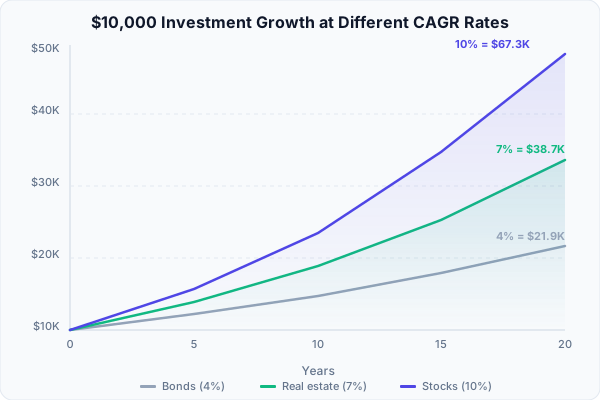
The CAGR formula takes only three inputs: a beginning value, an ending value, and the number of years between them. For a portfolio that grew from $50,000 to $82,000 over six years, the calculation yields an annualized return of roughly 8.6%. This number does not imply that the portfolio gained exactly 8.6% each year; rather, it tells you what constant rate of compound returns would have produced the same final balance. Financial planners rely on this distinction because it strips away short-term noise and highlights the long-run trajectory of portfolio appreciation. A 10% CAGR means your investment doubles roughly every 7.2 years.
CAGR vs Actual Year-by-Year Returns
One important limitation is that CAGR does not capture risk. Two portfolios can share identical compound growth rates yet exhibit vastly different volatility profiles. A stock fund might gain 25% one year, then lose 12% the following year, yet its CAGR smooths that volatility into a single figure. When risk-adjusted comparison matters, metrics such as the internal rate of return or the Sharpe ratio become valuable companions to measure true capital growth. Our guide on CAGR versus IRR explores that distinction in depth.
Stock Market CAGR Benchmarks
The S&P 500 has delivered a historical CAGR of approximately 10% over the past century, including reinvested dividends. Adjusted for inflation, that figure drops to about 7%. These numbers come from annual return data maintained by Aswath Damodaran at the NYU Stern School of Business.
Long-Term S&P 500 Performance
Between 1926 and 2024, this asset value increase averaged roughly 10.3% per year on a nominal basis. Inflation averages about 3% per year, reducing real investment returns to approximately 7%. Understanding the gap between nominal and real returns is essential for any long-term financial plan. Growth-oriented segments of the market often post even higher compound rates. The Nasdaq Composite, heavily weighted toward technology companies, has exhibited a 20-year CAGR closer to 12% as of late 2024.
Decade-by-Decade Variation
Shorter measurement windows paint a different picture. The decade ending December 2024 produced a CAGR near 13% for the S&P 500, buoyed by the extended post-2009 recovery and the technology-led rally of the early 2020s. Conversely, the decade starting in 2000 saw a CAGR below 2% as two major bear markets eroded gains. Such variation underscores why relying on a single decade to project future returns can be misleading.
Small-cap value stocks, tracked by indices like the Russell 2000 Value, have historically outperformed large caps over very long horizons, though with markedly higher drawdowns along the way. To model how a specific growth rate would compound your own capital, try the CAGR calculator on our homepage. Plug in your starting balance, target balance, and time horizon to see whether your expectations align with historical equity returns.
Real Estate CAGR Benchmarks
Residential real estate has a long-term CAGR of roughly 4% to 5%, based on national home price data from the Federal Housing Finance Agency's House Price Index. REITs have historically generated a CAGR between 8% and 10%, rivaling equities over multi-decade spans.
Certain metropolitan areas, notably San Francisco, Austin, and Miami, have outpaced the national average by several percentage points during recent decades, while rural markets have lagged behind. When rental income is factored in, total-return real estate performance improves significantly.
The FTSE Nareit All Equity REITs Index returned a 30-year annualized figure near 9.5% through the end of 2024, including dividends. This blended return makes REITs a popular choice for investors who want property exposure without the operational burden of direct ownership.
Raw land and commercial properties carry additional complexity. Capitalization rates, vacancy cycles, and renovation costs all influence effective compound returns. Investors who track these assets should consider reviewing detailed CAGR calculation examples to see how varying cash flows and holding periods change the annualized outcome.
Historical CAGR by Asset Class
The table below summarizes approximate nominal compound annual growth rates for major asset classes over the past several decades. These figures reflect broad market indices, include reinvested income where applicable, and are drawn from widely referenced institutional data sets.
| Asset Class | Representative Index | Approximate CAGR | Typical Measurement Period |
|---|---|---|---|
| U.S. Large-Cap Stocks | S&P 500 (total return) | ~10% | 1926 – 2024 |
| U.S. Small-Cap Stocks | Russell 2000 | ~11% | 1979 – 2024 |
| International Developed Stocks | MSCI EAFE | ~8% | 1970 – 2024 |
| U.S. Investment-Grade Bonds | Bloomberg U.S. Aggregate | ~5% | 1976 – 2024 |
| U.S. Treasury Bills | 3-Month T-Bill | ~3.3% | 1926 – 2024 |
| Residential Real Estate | FHFA House Price Index | ~4% | 1991 – 2024 |
| REITs (Equity) | FTSE Nareit All Equity REITs | ~9.5% | 1994 – 2024 |
| Gold | London Gold Fix (USD) | ~7.5% | 1971 – 2024 |
| Inflation (CPI) | U.S. CPI-U | ~3% | 1926 – 2024 |
Notice the spread between equities and bonds. Bonds produce a typical CAGR of about 5% for investment-grade issues, while large-cap stocks compounded at roughly double that rate. That gap represents the equity risk premium: the additional return investors demand for bearing higher volatility. Gold has delivered a CAGR of approximately 7.5% since 1971. Treasury bills barely outpaced inflation, illustrating why cash-heavy portfolios erode purchasing power over long horizons.
Using CAGR to Set Investment Goals
Define a target dollar amount and a deadline, then back-calculate the CAGR needed to bridge the gap. For example, growing $40,000 to $120,000 in ten years requires roughly 11.6% annually. Comparing that figure to historical benchmarks reveals whether your goal is realistic.
Back-Calculating Your Required Growth Rate
Once you know your required CAGR, compare it to the asset class table above. A target above 10% demands heavy equity exposure or alternative assets. Anything north of 15% enters venture-capital territory and carries corresponding risk. Periodic contributions reduce the growth rate your existing balance needs to achieve, making even ambitious targets more attainable.
Practical Steps for Goal-Based Investing
Several practical steps help turn an abstract CAGR target into a workable plan:
- Benchmark your expectation. A target CAGR above 10% demands heavy equity exposure or alternative assets.
- Account for contributions. CAGR assumes a single lump sum. Most investors add money regularly. Periodic contributions reduce the growth rate your existing balance needs to achieve.
- Adjust for inflation. Subtract roughly 3% from nominal CAGR to approximate real purchasing-power growth. A nominal 10% target becomes a real 7% target.
- Revisit annually. Recalculate CAGR each year with updated balances to track whether you are ahead of or behind your plan.
Diversification plays a critical role in reaching a CAGR target reliably. A portfolio split between equities, bonds, and real estate will not achieve the highest possible compound return, but it will narrow the range of outcomes. Narrower outcome ranges make planning far more predictable, which is precisely what long-term goal-setting requires.
For a deeper look at the math, visit the CAGR formula reference on CalculateGrowth, where each variable is explained with worked numerical examples. If you want to compare portfolios with irregular cash flows, the CAGR vs IRR comparison will help you pick the right metric. Tracking investment growth over time turns abstract goals into measurable milestones for your portfolio.