CAGR Calculation Examples
These CAGR calculation examples show step-by-step how to apply the compound annual growth rate formula to real salary, investment, and revenue scenarios. Each example walks through the algebra so you can repeat the process with your own numbers and check the result against our free calculator.
- Full Name
- Compound Annual Growth Rate
- Abbreviation
- CAGR
- Salary Example
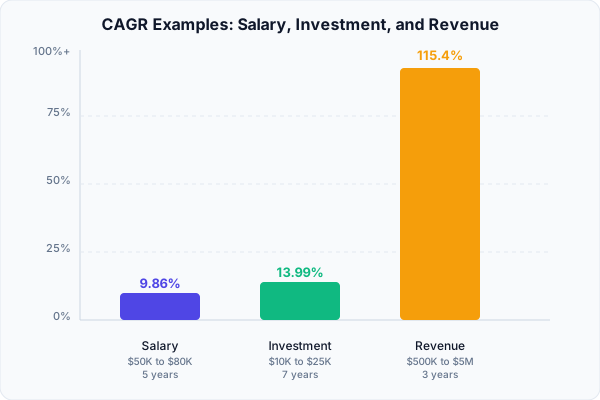
- $50,000 to $80,000 over 5 years = 9.86%
- Investment Example
- $10,000 to $25,000 over 7 years = 13.99%
- Revenue Example
- $500K to $5M over 3 years = 115.44%
CAGR stands for Compound Annual Growth Rate. It smooths out year-to-year fluctuations and distills multi-year change into a single annual percentage. Whether you are tracking salary progression, portfolio performance, or business revenue, the underlying arithmetic stays the same. These CAGR examples cover the three most common use cases. Below are four fully worked real-world CAGR scenarios you can follow along with, adapt to your own figures, and verify using our free CAGR calculator.
Each example uses the same core equation. Make sure you know the CAGR formula first.
Here, n represents the number of years between the beginning and ending measurements. The result is expressed as a decimal; multiply by 100 to convert it to a percentage.
Salary Growth CAGR Example
The salary CAGR example is the most common scenario our users calculate.
Suppose you earned $50,000 five years ago and your current annual salary stands at $80,000. A quick glance might suggest you received a 60% raise over the period, but that headline figure hides the compounding that happened each year. To find the annualised growth rate, plug the numbers into the formula.
Step-by-Step Walkthrough
- Divide the ending salary by the starting salary: $80,000 / $50,000 = 1.60
- Raise the result to the power of 1/5 (because the growth spans five years): 1.600.20 = 1.09856
- Subtract 1 and convert to a percentage: 1.09856 − 1 = 0.09856, or roughly 9.86% per year
A 9.86% CAGR means roughly a 10% raise every year for five years. That compound annual growth rate considerably outpaces the Bureau of Labor Statistics median wage growth of roughly 3–4% annually. That kind of salary acceleration often comes from a combination of promotions, job changes, and skill upgrades rather than from standard cost-of-living adjustments alone.
To quickly validate these numbers, punch them into the salary growth calculator on our homepage. The tool handles the exponent arithmetic for you and shows a year-by-year breakdown.
Investment Return CAGR Example
Each CAGR example below uses real numbers you can verify. An investor placed $10,000 into a diversified equity fund seven years ago, and the account balance today reads $25,000. Although the market experienced several volatile years in between, the CAGR captures the steady equivalent annual return that would have produced the same final balance. This ranks among the top compound return examples our CalculateGrowth users run.
Step-by-Step Walkthrough
- Divide ending value by beginning value: $25,000 / $10,000 = 2.50
- Compute the 7th root: 2.50(1/7) = 2.500.14286 = 1.13985
- Subtract 1: 1.13985 − 1 = 0.13985, which equals approximately 13.99% per year
The investment example produces a 13.99% yearly return. That annualised return sits above the long-run S&P 500 average of about 10% (nominal). Keep in mind that CAGR does not account for interim cash flows such as dividends reinvested or additional contributions. If your situation involves periodic deposits or withdrawals, the internal rate of return (IRR) is a better metric because it weights the timing of every cash movement.
According to Investopedia's detailed overview of compound annual growth rate methodology, CAGR is most useful when comparing the historical performance of two investments over identical time horizons without the noise of year-to-year volatility. These compound return examples act as a smoothed lens rather than a record of every dip and peak along the way.
Startup Revenue CAGR Example
Revenue CAGR for startups often exceeds 100% in early stages. Startup growth often looks explosive in absolute terms, but quantifying it with a single annual metric helps investors compare one venture against another. Consider a SaaS company that generated $500,000 in annual recurring revenue three years ago and has since scaled to $5,000,000. Among annualized performance cases, this kind of hypergrowth stands out dramatically.
Step-by-Step Walkthrough
- Divide: $5,000,000 / $500,000 = 10.00
- Take the cube root (since n = 3): 10.00(1/3) = 10.000.3333 = 2.15443
- Subtract 1: 2.15443 − 1 = 1.15443, giving a compound annual growth rate of roughly 115.44% per year
A 115% rate is remarkable but not unusual for early-stage software businesses scaling from a small base.
Venture capital benchmarks from firms like Bessemer and a16z commonly cite "triple, triple, double, double" as a healthy SaaS trajectory, which implies year-over-year growth rates well above 100% in the earliest stages. As the revenue base grows, maintaining triple-digit CAGR becomes harder. Most Series B companies slow to 40-75% annualised growth, and by Series C the median drops further. This deceleration is normal and expected in the startup lifecycle.
What Does a 115% CAGR Look Like?
A 115% compound annual growth rate means the business roughly doubles its revenue each year and then some. One limitation worth noting: the CAGR treats the growth path as perfectly smooth, masking any quarters where revenue may have dipped due to churn or seasonal effects. For a more granular picture, break the timeline into shorter intervals and calculate separate growth rates for each period, then compare them against the aggregate figure.
Reverse CAGR: Finding Future Value
The reverse CAGR formula solves for future value instead of growth rate. Sometimes you know the desired annual growth rate and want to work backwards to determine what your ending value will be. This "reverse" application rearranges the standard formula to solve for the future amount.
Scenario
You currently earn $65,000 and want to know what your salary should reach in 8 years if you sustain a 7% compound annual growth rate.
- Add 1 to the decimal growth rate: 1 + 0.07 = 1.07
- Raise to the power of 8: 1.078 = 1.71819
- Multiply by the present value: $65,000 × 1.71819 = $111,682
A 7% annual rate turns $65,000 into $111,682 over eight years.
This reverse approach turns a growth assumption into a concrete dollar target. Adjust the rate up or down to model optimistic and conservative scenarios side by side. Try 5% for a cautious outlook or 10% if you plan aggressive job switching. The gap between those projections shows how sensitive long-term outcomes are to even small differences in yearly growth.
For a deeper look at the algebra behind these rearrangements, visit our complete CAGR formula guide, which walks through each derivation and explains when to use logarithmic forms.
How Do These CAGR Examples Compare?
The three CAGR examples above differ dramatically by domain: salary at 9.86%, investments at 13.99%, and startup revenue past 115%. Review these CAGR examples before running your own numbers.
That spread matters. A 9.86% salary CAGR already outpaces the BLS median by a wide margin, yet it looks modest next to a startup's triple-digit revenue growth. Context determines whether a given rate is strong or weak. Comparing annualized figures across categories makes it easy to benchmark your own situation against common real-world outcomes and set targets that match your career stage, risk tolerance, and industry norms.
Key Takeaways and Next Steps
- The CAGR formula works identically whether you are measuring salary progression, portfolio returns, or business revenue. Only the input numbers change.
- Annualised growth rates enable apples-to-apples comparisons across different time horizons, stripping out the noise of yearly fluctuation.
- When interim cash flows matter—such as ongoing 401(k) contributions or investor funding rounds—IRR provides a more accurate picture than CAGR alone.
- Reversing the formula lets you project future values from a target growth rate, which is useful for goal-setting and financial planning.
- Always sanity-check your result. A quick way: use our online CAGR calculator and compare the output with your manual arithmetic.
These CAGR examples cover the core scenarios you need. Head over to the CalculateGrowth calculator and plug in your own starting value, ending value, and time period to get an instant result.